
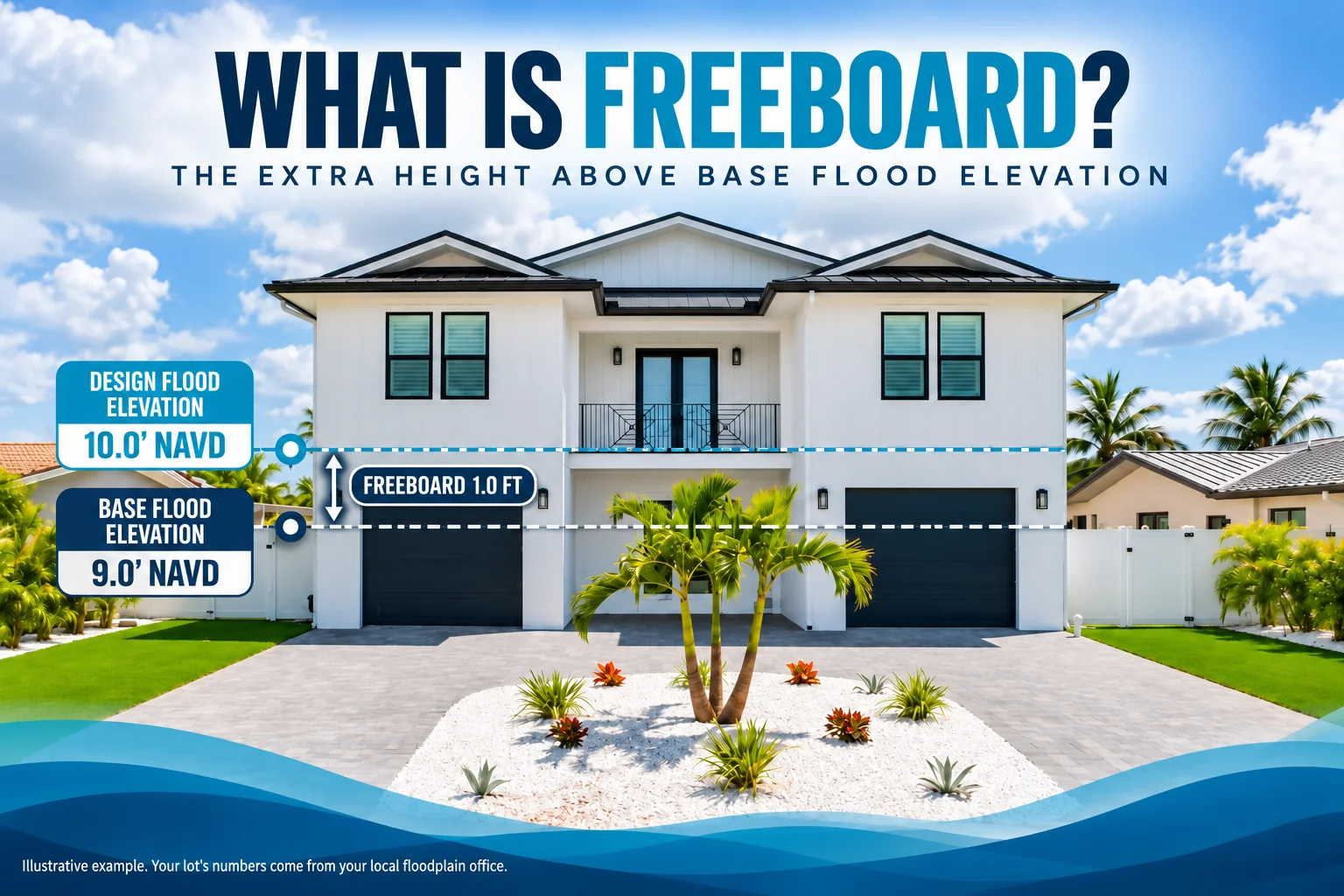
Short answer: Freeboard is extra height built in above the base flood elevation (BFE). In Florida, the statewide building code sets the lowest floor of most homes in flood zones at least 1 foot above the BFE, and many local communities require more. Your local floodplain office confirms the number for your lot.
Key terms
- Base flood elevation (BFE): the height floodwater is expected to reach in a base flood, shown on FEMA flood maps.
- Freeboard: extra height above the BFE, either required by local rules or chosen by the owner.
- Design flood elevation (DFE): the elevation actually used to design the home. It can be the BFE plus freeboard, or a higher number set by a local flood map.
- Lowest floor: the floor that is checked against the required elevation. How it is measured depends on the flood zone.
How freeboard is measured
Freeboard is measured straight up from the BFE. If the BFE on your lot is 10 feet and your community requires 2 feet of freeboard, the home is designed to 12 feet.
In coastal high-hazard areas (V zones), the measurement is taken at the bottom of the lowest structural beam that holds up the home, not the floor surface. That is one reason homes near open water often sit higher than homes a few streets back. Our guide to building in a V zone explains what happens below an elevated home in those areas.
How much freeboard does Florida require?
The Florida Building Code applies across the state. For homes in most flood zones that start with “A”, it requires the lowest floor to be at or above the BFE plus 1 foot, or the design flood elevation, whichever is higher (Florida Building Code, Residential, Section R322.2.1, as quoted by the Florida Division of Emergency Management).
Many cities and counties go further and adopt more freeboard, so the right number depends on where your lot is. Before you design, ask your local floodplain administrator or building department for:
- the BFE and flood zone for your lot,
- any freeboard your community adds, and
- the design flood elevation they will check at permit.
Why build above the minimum?
- More room between your home and the water. Every foot above the BFE adds distance between your living space and the expected flood level.
- Flood maps change. BFEs can be updated when FEMA restudies an area. Extra height gives you some margin if the number goes up later. Our BFE guide covers how and why maps change.
- It may help with flood insurance. How high the home sits compared with the flood level can be part of how a policy is priced. Ask your insurance professional how elevation affects your quote.
- Equipment stays higher too. Utilities and mechanical equipment are also kept above the design flood elevation, so freeboard affects more than the floor.
What freeboard means for your home’s design
Extra height changes more than the foundation. It can affect:
- Stairs and access. A taller ground floor means more steps. Many owners add an elevator or lift.
- Height limits. Local zoning sets a maximum building height. More freeboard can use up some of that allowance, so it is worth checking early.
- The ground floor. The space under an elevated home is usually parking, storage and covered outdoor space, built to flood rules.
Because every lot and every community is different, these decisions are best made with your survey and local requirements in hand.
How Seasafe approaches elevation
Seasafe builds elevated coastal homes using the Two-Site Construction Model. The concrete and steel ground floor is built on your lot while the living space sections are built at our Build Center, then set on top. Every Seasafe home is designed to the FEMA flood requirements and local flood codes that apply to its homesite.
We start with the lot: the survey, the BFE, local freeboard and height limits. One Seasafe-built home that received a 2025 Mark Samuelian Award in Residential Resilience (Resilience Action Fund) sits 17 feet up, four feet above the elevation its local code required.
Talk to us about your lot
Send us your address and we will walk through what your site allows, including the BFE, local freeboard and height limits.
