
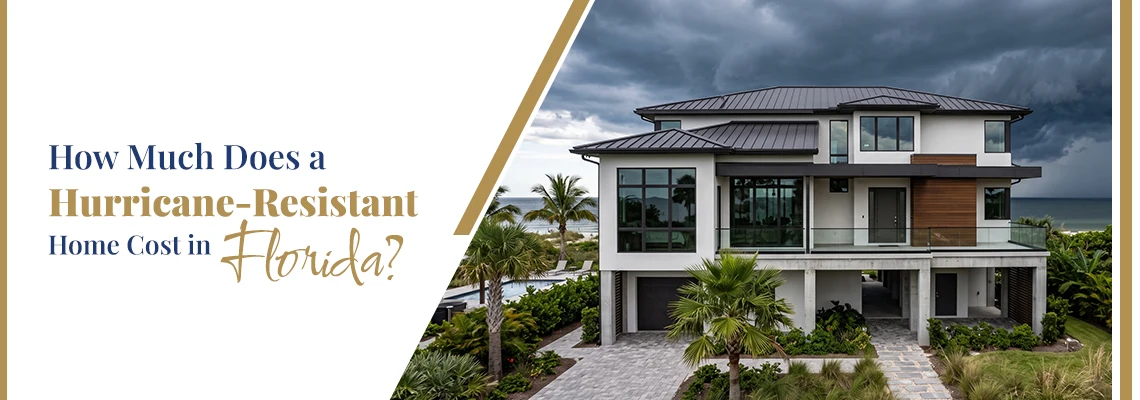
If you’re planning to build a home in Florida, one of the first questions you’ll probably ask is: How much will it cost to make it hurricane-resistant?
The answer isn’t as simple as adding a few storm upgrades to a standard home. Every factor like location, flood zone, elevation requirements, structural system, and the level of wind protection all influence the final cost.
For many custom builds, a non-elevated hurricane-resistant home cost in Florida falls between $250 and $500+ per square foot. However, luxury coastal homes or properties requiring extensive elevation and engineering can cost more, sometimes much more given the additional work and materials required to build in flood risk areas. Home prices for a new custom build can exceed $1000 per square foot to construct a custom built home that this hurricane resistant, having dedicated features to provide flood and wind resistance during storms.
The price covers far more than stronger walls or impact-rated windows. It also includes structural engineering, foundation design, code-compliant construction, and building techniques that are ideal for Florida’s coastal environment.
Knowing which features improve a home’s ability to withstand hurricanes can help you make smarter building decisions and better evaluate the overall investment.
This blog explains what affects hurricane-resistant construction costs, which building methods to consider for Florida coastal homes, and where investing more upfront can reduce long-term expenses.
What Does “Hurricane-Resistant” Actually Mean in Florida?
A hurricane-resistant home is built to perform better during hurricanes by meeting Florida’s structural and wind-resistance standards. Instead of relying on a single feature, it combines engineered foundations.
The homes have reinforced framing, impact protection, and code-compliant construction to help reduce storm damage. Many homeowners also compare the hurricane-resistant home cost in Florida before deciding on a design.
The following points explain the concepts better:
Florida Building Code and Wind Requirements
Florida has some of the strictest residential building codes in the country because of its exposure to hurricanes. Every new home must meet structural standards based on its location, expected wind speeds, and local construction requirements.
Some of the key requirements include:
- Structural designs engineered for the property’s designated wind zone.
- Continuous load paths that transfer wind forces from the roof to the foundation.
- Impact-rated windows and exterior doors in windborne debris regions.
- Reinforced roof systems and approved fastening methods.
- Inspections throughout construction to verify code compliance.
Wind Resistance vs. Flood Protection
Wind resistance and flood protection address two different hurricane risks. A home that performs well during high winds may still be vulnerable to flooding. It is essential to ensure that your home is properly elevated or designed for water exposure.
Wind-resistant features help protect against:
- Roof uplift
- Flying debris
- Structural movement
- Window and door failures
- High-pressure wind loads
Flood-resistant features help reduce damage from:
- Storm surge
- Rising floodwaters
- Water intrusion
- Soil erosion around the foundation
- Moisture-related structural damage
What High-Wind Performance Actually Means
Homes designed for higher wind performance are built to reduce damage during major storms. In reality, no residential home can guarantee complete protection during an extreme storm.
Homes designed for higher wind performance typically include stronger structural systems and additional engineering. This can again impact the high-wind performance home cost.
These upgrades often include:
- Reinforced roof-to-wall connections.
- Stronger structural framing.
- Enhanced foundation systems.
- Impact-rated windows and doors.
What Factors Affect the Cost of a Hurricane-Resistant Home?
By now, you know the meaning of a hurricane-resistant house in Florida. The next thing you need to learn is what actually determines the cost to build a coastal home.
Ideally, the process of constructing the residence isn’t determined by one feature alone. It depends on where the home is built, how it’s designed, the materials used, and the level of protection required to meet local building codes.
Since these factors are so important, learning them will give you a clear picture of the cost to build a hurricane-resistant coastal home. You will be able to invest in features that improve safety, durability, and long-term value.
Location and Wind Zone
Where you build your coastal home has a significant impact on construction costs. Florida’s coastal communities typically have stricter wind design requirements. This can again increase the engineering, materials, and labor costs.
Some location-based factors that influence pricing include:
- Required design wind speeds.
- Local permitting and inspection requirements.
- Coastal exposure and windborne debris regions.
- Availability of skilled contractors and materials.
- Regional labor and transportation costs.
Flood Zone and Required Elevation
Flood risk is another major factor that affects your construction costs. Properties located within FEMA flood zones often require elevated foundations to meet local regulations and reduce the risk of flood damage.
Depending on the site, additional costs may include:
- Elevated pile or pier foundations.
- Additional structural engineering.
- Higher foundation materials and labor costs.
- Site grading and drainage improvements.
- Compliance with Base Flood Elevation (BFE) requirements.
Home Size and Design
Larger homes generally cost more to build. This is because these homes require additional materials, labor, and engineering. However, the home’s layout and architectural complexity can have just as much impact on the final budget.
Features that commonly increase construction costs include:
- Multiple stories.
- Large window openings.
- Complex roof designs.
- Expansive outdoor living areas.
- Custom architectural details.
- Luxury interior finishes.
Foundation Type
Your coastal home’s foundation supports its structure and protects it from flooding. The right choice depends on the property’s elevation, soil conditions, flood zone designation, and local building requirements.
Common foundation options include:
- Slab-on-grade foundations.
- Stem wall foundations.
- Pier foundations.
- Pile foundations for coastal properties.
- Elevated foundations in flood-prone areas.
Construction Materials
The structural materials used throughout the home have a direct impact on durability, maintenance, and overall construction costs. However, some systems may require a higher upfront investment that offers greater resistance to wind, moisture, and long-term wear.
Material selection may influence:
- Structural strength.
- Wind performance.
- Moisture resistance.
- Maintenance requirements.
- Construction timelines.
- Long-term ownership costs.
Hurricane-Resistant Home Costs by Florida Region and Wind Zone
Construction costs on Florida’s Gulf Coast vary significantly by location, flood zone, required elevation, and site-specific conditions. Rather than quoting a statewide range, Seasafe works with homeowners to evaluate their specific property and provide a clear picture of what drives cost for their project. If you are building or rebuilding on Florida’s Gulf Coast, our team can walk you through what to expect for your site.
How Construction Methods Affect Hurricane-Resistant Home Costs?
The construction method you choose has a direct impact on your home’s strength, energy efficiency, and overall cost. Some systems may require a larger investment, but they offer better long-term performance in Florida’s coastal environment.
It is the primary reason you need to select the right construction material:
Wood Frame
Wood framing is one of the most common residential construction methods because it’s widely available and generally costs less than other structural systems. However, homes in high-wind coastal areas often require additional reinforcement to meet local building codes.
Some advantages include:
- Lower initial construction cost.
- Faster installation.
- Flexible design options.
- Easier future renovations.
Concrete Block (CBS)
Concrete block construction offers excellent durability and wind resistance. It also performs well in humid conditions with proper construction and maintenance.
Homeowners often choose CBS for its:
- Strong structural performance.
- Better resistance to moisture and pests.
- Long service life.
- Lower maintenance requirements.
ICF
Insulated Concrete Forms (ICF) combine reinforced concrete with permanent insulated forms. It creates a strong, energy-efficient building envelope. When comparing concrete block vs ICF in Florida, the insulated version provides better structural performance.
Benefits of ICF include:
- Excellent wind resistance.
- Improved energy efficiency.
- Better sound insulation.
- Greater structural strength.
Steel
Steel framing is commonly used for homes that require exceptional structural strength or modern architectural designs. It offers excellent durability when properly engineered.
Steel construction offers:
- High strength-to-weight ratio.
- Resistance to termites and rot.
- Dimensional stability.
- Long-term durability.
Seasafe Homes’ Coastal Home Construction Approach
At Seasafe Homes, we build elevated coastal homes on Florida’s Gulf Coast, serving communities including Indian Rocks Beach, Clearwater Beach, St. Pete Beach, Madeira Beach, Longboat Key, and surrounding areas. Every home is designed around the specific conditions of the property: its flood zone, elevation requirements, site constraints, and local permitting.
Our Two-Site Construction Model sets us apart from a traditional on-site build. Living space sections are built in our Build Center while foundation and site work moves forward at the property at the same time. This parallel process helps reduce timeline risk and gives us greater control over quality and scheduling, which matters on a coastal project where local conditions, permitting, and weather can all affect how a build unfolds. We focus on elevated coastal homes that are engineered for Florida’s wind and flood-zone requirements, built with durable structural systems, and designed to offer long-term value on the coast. If you’re planning to build or rebuild on Florida’s Gulf Coast, our team can walk you through the process from site evaluation to certificate of occupancy.
Every project is planned with:
- Site-specific engineering.
- Two-Site Construction Model.
- Durable structural systems.
- Elevated foundations when required.
- Hurricane-resistant construction practices.
- Efficient project planning and execution.
Cost of Hurricane-Resistant Features
By now, you know that a hurricane-resistant home combines multiple structural features. It helps to improve its ability to withstand high winds and severe weather.
While some are required to meet Florida’s building codes, others are optional upgrades that can enhance long-term durability and performance.
The following factors can impact the hurricane-resistant home costs in Florida:
1. Sustainable Windows and Doors
The product rating, size, frame material, and installation requirements can impact window costs in Florida.
2. Hurricane-Resistant Roofing
A hurricane-resistant roof cost varies depending on the roofing material, roof design, and overall roof size.
3. Roof-to-Wall Connections
Roof-to-wall connections are a relatively small investment that plays a major role in improving a home’s ability to withstand hurricane-force winds.
4. Reinforced Structural Systems
The level of reinforcement depends on the home’s design, location, and required wind rating.
5. Elevated Foundations
Elevated foundations are often required for homes built in FEMA flood zones. The additional cost depends on the required elevation, foundation type, and site conditions.
6. Water-Resistant and Flood-Resilient Features
Flood-resilient features, such as moisture-resistant materials and corrosion-resistant components, require extra cost.
7. Engineering, Permits, and Inspections
Every hurricane-resistant home needs structural engineering, permit approvals, and inspections throughout construction. These essential services contribute to the overall project cost while ensuring the home complies with Florida’s building rules.
New Construction vs. Retrofitting an Existing Florida Home
While retrofitting works well for some homes, new construction gives you the opportunity to incorporate hurricane-resistant features into the original design.
Such an approach is often more efficient than upgrading an existing structure piece by piece. Your final decision should depend on your home’s age, the upgrades required, coastal home building timeline, and your long-term goals.
Comparing both options can help you determine which approach offers the best value for your investment. The following table helps you understand the concept better:
|
Factors |
New Construction |
Retrofitting an Existing Home |
|
Planning |
Hurricane-resistant features are included from the design stage. |
Upgrades need to be added to your home’s existing structure. |
|
Construction Cost |
Higher upfront investment but easier to manage during the build. |
Costs vary depending on the number and complexity of upgrades. |
|
Structural Changes |
Integrated into the original construction. |
May require demolition and structural modifications. |
|
Building Code Compliance |
Designed to meet current Florida codes from the start. |
Some upgrades may trigger additional code requirements. |
|
Construction Timeline |
Follows a planned construction schedule. |
Timelines can increase if hidden structural issues are discovered. |
|
Long-Term Value |
Better opportunity to optimize durability, energy efficiency, and storm protection. |
Improves an existing home’s resilience but may have design limitations. |
Home size is one factor in the overall budget, but location, flood zone, foundation type, elevation requirements, and finish selections all play an equally important role. Providing accurate cost estimates without understanding the full scope of a specific project is difficult. For a thorough breakdown of what actually drives coastal construction costs on Florida’s Gulf Coast, see our guide: What Actually Determines the Cost to Build a Coastal Home in Florida?
Can a Hurricane-Resistant Home Lower Your Insurance Costs?
Hurricane-resistant features may help reduce your insurance costs. Whether your home qualifies for premium reductions depends on its construction, location, and your insurer’s requirements.
Residences built with hurricane-resistant features may qualify for lower insurance premiums. This is because they present a lower risk of storm-related damage.
However, the amount you save depends on your home’s construction, location, and your insurance provider.
-
Wind Mitigation Inspections
A wind mitigation inspection in Florida helps evaluate features that improve a home’s resistance to hurricane damage. Insurers use this report to determine whether the home qualifies for premium reductions.
The inspection typically reviews the roof shape and covering, roof-to-wall connections, opening protection, and secondary water resistance.
-
Potential Insurance Discounts
Homes with qualifying mitigation features may be eligible for a Florida hurricane insurance discount. Even though the savings may vary, a strong house would help make long-term savings.
Ideally, insurers often check whether the house has impact-rated windows, reinforced roofing systems, and engineered structural connections. It helps them calculate the premiums.
-
Why Savings Vary by Home and Insurer
Your home’s location, age, construction type, coverage limits, and the insurer’s underwriting guidelines all influence the final premium.
It is therefore essential to discuss the potential discount with an insurer before building a coastal home in Florida. Such choices will help you prioritize features that offer both better storm protection and long-term financial value.
Ways to Reduce Hurricane-Resistant Home Costs Without Cutting Safety
By now, you are aware of the factors that influence the costs of owning a new coastal home in Florida. However, building a hurricane-resistant home doesn’t always mean stretching your budget.
Making informed decisions early in the planning process can help you control costs. Taking such an approach will help you make a smart choice without compromising safety or code compliance.
The following tips can help you reduce the costs of hurricane-resistant coastal home:
- Choose a simple floor plan to reduce structural complexity.
- Your newly constructed house must fulfill the Florida Building Code wind requirements.
- Select cost-effective materials that still meet Florida’s building standards.
- Incorporate hurricane-resistant features during initial construction instead of adding them later.
- Optimize the home’s design to minimize unnecessary engineering costs.
- Build on a site that requires less grading or elevation, when possible.
- Work with an experienced coastal builder who understands local codes and permitting requirements.
- Prioritize long-term durability over short-term savings.
Build Smarter Homes for Florida’s Coast with Seasafe Homes
The hurricane-resistant home cost in Florida that homeowners pay depends on much more than square footage. Your home’s location, structural system, elevation, materials, and level of storm protection all shape the final investment.
Planning with these factors in mind helps you build a home that can perform well in Florida’s weather. In this regard, taking the help of a professional builder can prove to be fruitful in the long run.
At Seasafe Homes, we build elevated coastal homes that are stable, efficient, and offer long-term value. We plan our projects around your property’s unique conditions while maintaining transparency throughout the construction process.
If you are still confused, simply list the questions to ask a coastal home builder in Florida before making an informed decision. Our team will resolve all your queries and help you make the right investment.
Build a coastal home that’s ideal for Florida’s toughest conditions by connecting with Seasafe Homes today!
