
What does it cost per square foot to build a coastal home in Florida?
Cost per square foot is one of the least reliable ways to evaluate a coastal home build. Elevated homes in flood zones vary widely based on foundation design, lot conditions, finishes, and timeline. Two homes with the same floor plan can differ in cost by over $150,000 before construction even begins.
Yet, this is still the first question most buyers ask for a simple reason. It feels like an easy way to compare builders using one number that could lead to an easy decision.
The problem is that not all builders measure the same thing, and not all homes include the same scope of work, finish, and design. Some quotes are based on conditioned square footage. Others include total under-roof area. Some include site work and utilities. Others do not. Without consistent definitions, cost per square foot creates false comparisons that lead to budget surprises later.
Coastal construction adds another layer of complexity. An elevated home may have 2,500 square feet of living space, but 6,000 square feet of total square footage of structure when you include porches, decks, and the ground floor areas below. These areas require full structural systems and hurricane engineering, but they are often excluded from the per-square-foot calculation.
The time to build a coastal home averages 18 months from the start of construction. There are many variables that affect the timeline, but they all add up to a considerable cost through taxes, insurance, lost income potential, and being displaced from a home.
What drives the cost of a coastal home comes down to four main factors:
- Foundation and elevation requirements
- Lot-specific conditions and utilities
- Finish selections and design choices
- Time is one of the largest hidden costs
Understanding these variables gives you a far more accurate picture of total project cost than any price per square foot.
This article breaks down each of these factors and explains how to evaluate the true cost of building a coastal home in Florida.
Quick Summary: What Drives Coastal Home Costs
If you are trying to estimate the cost of a coastal home in Florida, focus on these four areas. If you compare different builders, make sure the details are comparable:
- Pilings, flood zones, and ground floor design drive major cost differences
- Utilities, soil, water table, and site access vary widely by property
- Roofing, windows, flooring, and interior selections can shift the cost by over $100,000
- Longer build times increase interest, insurance, and lost income
Typical Coastal Home Cost Range
Most buyers want a simple number to compare builders and evaluate their budget. Coastal construction does not work that way because every project is unique, which creates a wide price range.
Coastal home prices range from $300 to over $1000 per conditioned square foot, depending on the scope of the project. Total project costs will vary based on the land, elevation, and finishes. That range is not a quote; it’s a starting point.
These are examples of what moves a project towards the lower end of the price range:
- Simply a ground-floor design
- Standard finish selections
- Local codes and lot buildability
- Favorable soil conditions
These are examples of what moves a project to the higher end of the price range:
- Complex ground floor enclosures
- Premium finishes with maximum glass openings
- Waterfront, irregular, and deep oversized lots with additional utility needs
- More complex structural requirements in higher impact zones
The total project cost is more important than the price per square foot.
A $900,000 home and a $1,200,000 home may have the same floor plan but very different site conditions, finishes, and timelines.
Time is an often-overlooked expense. While time does not have a line item on the estimate, it has the potential to be a major expense. Carrying and opportunity costs can accumulate to over $100,000 during the duration of the build.
The Tampa Bay coastal market has a high demand because of its beautiful beaches, excellent boating, and local amenities, which can make construction in the area more expensive than others.
Before You Compare Any Numbers, Agree on What’s Being Measured
The first problem with cost per square foot is that builders don’t all measure the same thing. Some quote conditioned square footage (the heated and cooled living space inside the home) while others use total under-roof area. Some builder quotes will include site work, driveways, and landscaping in the per-square-foot number. Others don’t. When you ask two builders for a cost per square foot, it’s almost guaranteed that you’re comparing different definitions of what’s included in the cost per square foot, not just different prices of the same project.
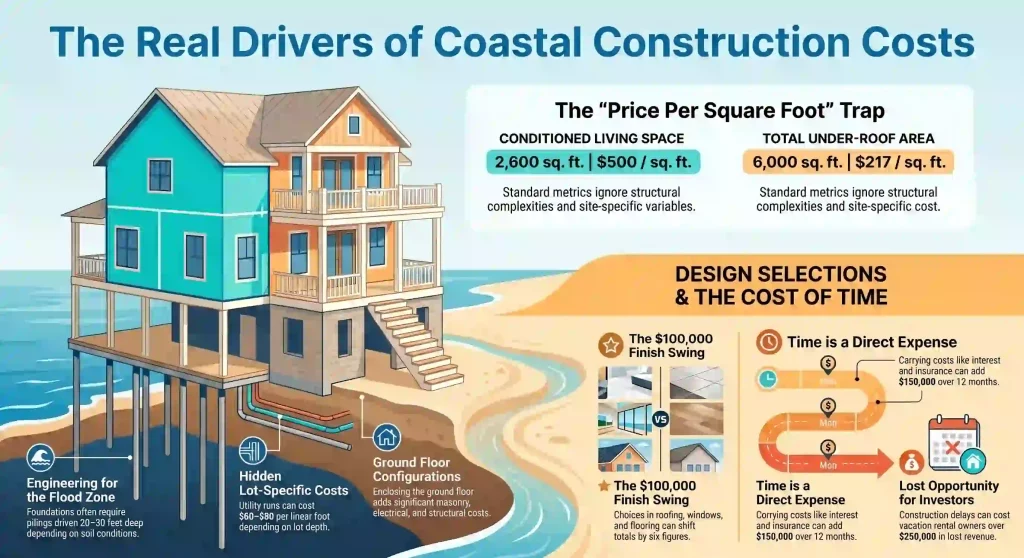
This matters especially for elevated coastal homes, where the gap between conditioned square footage and total square footage can be substantial. Consider a Seasafe elevated home: 2,600 square feet of conditioned living space is the number most often referenced for bedroom count, layout, and pricing comparisons. But the total built square footage of that same home is closer to 6,000 square feet, a difference of 3,400 square feet that isn’t factored into the price per square foot number quoted. Seasafe quotes are based on the conditioned space, not the total, even though there is a substantial difference between the two.
Where does the difference in the square footage come from? Approximately 1,000 square feet is accounted for in covered outdoor porches and decks, the spaces coastal homeowners use constantly for dining, entertaining, and watching the water. These areas require full foundation support, structural framing, and roofing. They’re built to the same hurricane engineering standards as the interior, which makes them expensive to build. But they don’t count as conditioned square footage, so they disappear from the per-square-foot pricing.
The remaining difference — approximately 2,400 square feet — is the enclosed ground floor. On an elevated coastal home, the ground floor sits below the living space and above the base flood elevation. It’s where you park vehicles, store boats and coastal equipment, and house mechanical systems protected from storm surge. Building it requires concrete, masonry walls, multiple door types, a full electrical system, and the same deep piling foundation that supports the rest of the structure. It is not a cheap space. It just isn’t counted as conditioned square footage.
Here is the price per square foot comparison if the above home costs $1,300,000 to build, and uses the different square footage calculations:
- $500 per square foot cost when only using conditioned space
- $217 per square foot when using the total space
A buyer comparing a Seasafe home quoted at a certain price per conditioned square foot against a competitor quoting total under-roof area is making a comparison that doesn’t hold up. Before any number means anything, you need to know exactly what square footage is being measured and exactly what costs are being included.
Why Cost Per Square Foot Doesn’t Tell the Full Story
Cost per square foot is a useful metric in standard construction, where homes are similar in size, sit on comparable lots, and are built with similar materials. On the Florida coast, almost none of those conditions apply.
Two homes with identical floor plans using the same bedrooms, same bathrooms, same square footage can end up with meaningfully different construction costs based on lot conditions, ground floor design, finish selections, and site-specific engineering requirements. None of that shows up in a per-square-foot number until the project is fully scoped.
There’s also a structural reason why smaller homes cost more per square foot than larger ones: fixed costs don’t scale with size. On a smaller home, the fixed costs, like engineering, survey, and site testing, are divided across fewer square feet, which makes the per-square-foot number look higher even though the total project cost is lower. A smaller home is usually less expensive to build overall. It just doesn’t look that way on a per-square-foot basis.
The Variables That Actually Drive Cost
Coastal construction costs are shaped by four categories of variables. Understanding each one gives you a far more accurate picture of what a project will cost than any per-square-foot estimate.
1. Foundation and Structural Requirements
The foundation is where coastal construction diverges most sharply from standard residential buildings. Elevated homes in Florida flood zones commonly require deep pilings, which are typically driven 20 to 30 feet into the ground where they are anchored based on site-specific geotechnical soil boring testing. Soft soils or high water tables require deeper anchoring, which adds cost. Solid ground closer to the surface can reduce it. No two lots are identical.
Ground floor configuration is another major cost driver. An open column design, with no enclosure or garage doors, but allows for open parking under the home, is the most cost-effective approach. An enclosed ground floor with garage doors, side entries, electrical service, and masonry walls adds functionality and usefulness but also cost: concrete, steel, multiple door types, and a complete electrical system for the enclosed space. The decision is often driven by lifestyle needs (boat storage, golf carts, pool equipment) rather than budget alone, but buyers should understand the cost difference going in.
Building height requirements also vary by municipality and proximity to water. Velocity zones near the waterfront can mandate specialized wall construction methods, like breakaway walls, that add both material and labor cost. A flood map review and topographic survey with local code review are required before any of these numbers can be estimated accurately.
2. Lot-Specific Variables
The lot itself introduces cost variables that have nothing to do with the floor plan. Electrical service distance is commonly underestimated: installation runs approximately $60 to $80 per linear foot. A lot with a 100-foot run from the street to the meter can cost $6,000 to $8,000 for electrical service alone, compared to $2,000 to $3,000 for a standard 20- to 30-foot run. Deep or irregularly shaped lots amplify this difference.
Job sites near the water often require active dewatering during foundation work, adding both time and equipment cost. Fill dirt requirements vary by lot elevation. Utility availability and municipal impact fees differ across Florida’s coastal jurisdictions. None of these variables are visible in a floor plan price.
3. Finish Selections
Finish selections are where two homeowners with identical floor plans can end up with a $150,000 spread in final cost. The differences compound quickly across a home.
Roofing is one of the largest single variables. A standing seam metal roof on a 3,000+ square foot home can cost $40,000 to $60,000 more than standard shingles. That’s a single finish selection with a major cost impact. Windows and doors are another: all Seasafe Homes are built with hurricane-rated impact windows and doors, but frame color, black vs. white, can change the cost by approximately $100 to $200 per window. On a 2,500 square foot home with 25 windows, that’s over a $2,000 difference for one cosmetic choice. Slider door sizes add to the cost discussion: a 9-foot by 8-foot three-panel glass slider costs significantly more than a standard single door, both in materials and in labor, since the larger units require multi-person installation.
Tile selections illustrate how per-unit differences multiply. For example, a tile that costs $4 per square foot versus one at $50 per square foot doesn’t sound dramatic until you’re tiling 1,500 square feet of kitchen backsplash, floors, and showers. Exterior railing systems are both important security features and an aesthetic focal point of an elevated home. A painted wood spindle with a composite top may be priced around $3,000, while a powder coated, horizontal aluminum railing can change the pricing by $18,000 to $20,000. Same function, six times the cost.
Interior selections follow the same pattern. Flooring at $8 per square foot installed versus $12 to $14 per square foot creates a $15,000 to $20,000 difference across a home. Quartz countertops vary by thousands depending on the style selected. Appliance packages span from functional to high-end. Each decision is relatively small in isolation. Combined, they define a wide cost range around the same base floor plan.
Given the nature of elevated homes, customers are also deciding on how they want to access the living floors. Do they want to use front and rear stairs? Or maybe they want to install an elevator which will impact the electrical, foundation, and cost of the elevator itself. At Seasafe an elevator can be installed for $29,000 or we can design the home with an elevator shaft for future installation.
This is one reason Seasafe Homes uses a curated design selection process. Rather than presenting thousands of individual material options, we offer professionally designed finish packages (Simplicity and Style collections) that reduce decision-making from over 1,500 choices to approximately 150 focused selections. This protects both the construction schedule and the project budget and reduces the risk of cost surprises late in the process.
4. Construction Method and Timeline
There is a fourth cost driver that rarely appears in a per-square-foot estimate: time. In coastal construction, the length of the build is not just a scheduling inconvenience, it is a direct financial cost.
Traditional coastal home construction in Florida takes 18 to 24 months. Let’s give an example using some recent costs for a homeowner building a $925,000 elevated coastal home. The case study assumes there is construction loan interest at roughly $4,625 per month, builder’s risk insurance and property taxes totaling another $1,100 per month, and in most cases, rent at $3,000 or more per month while waiting to move in. Over twelve extra months, that adds up to approximately $150,000 in carrying costs. Money that doesn’t buy a single square foot of home.
For investors building a rental property on the same budget, the math is more severe. A Gulf Coast vacation rental generating $13,000 per month in income doesn’t start producing revenue until the certificate of occupancy is issued. Twelve extra months of construction means approximately $160,000 in lost rental income potential, plus the same carrying costs as above. Total time impact is over $265,000.
When you factor time cost into the true price of building, a home that appears to cost $507 per conditioned square foot at the construction contract price ends up costing $580 per square foot for a homeowner who waited an extra year, and $652 per square foot for an investor who lost out on the potential rental income during construction. The cost per square foot changed, not because anything in the home changed, but because of time.
Seasafe Homes builds using a Two-Site Construction process: living spaces are constructed in a controlled Build Center while foundation and ground floor work progresses onsite in parallel. This approach eliminates most weather-related delays and compresses the schedule to typically 6-8 months, a year or more faster than traditional coastal construction. For a homeowner or investor evaluating true cost to build, that time difference is not a footnote. It is one of the largest line items in the project.
Summary: The Variables That Actually Drive Cost
Foundation and Structural Requirements
This is the largest cost difference in coastal construction compared to now coastal homes.
Homes in flood zones require deep pilings, often 20 to 30 feet.
Soil conditions determine depth and cost.
Ground floor design also matters.
- Open column design is most cost-effective
- Enclosed ground floors add concrete, walls, doors, and electrical
Flood maps and local zoning also impact cost.
Homes near the water may require additional structural systems to meet higher wind and wave potential exposure.
Lot-Specific Variables
Every lot is different.
Key cost drivers can include:
- Electrical service distance from the street, often $60 to $80 per foot
- Dewatering requirements near water for a coastal lot
- Fill dirt and grading
- Local impact fees and utilities
A deep lot or waterfront lot can add significant cost without changing the home design.
Finish Selections
This is where costs can vary the most.
Some Finish Examples that Impact Square Foot Cost:
- Metal roof vs shingles can add $40,000 to $60,000
- Window color choices can add thousands
- Tile ranges dramatically from $4 to $50+ per square foot
- Including an elevator can add $29,000
- Railing systems can range from $3,000 to $20,000
These selection decisions add up.
- Seasafe addresses this with curated selections.
- Simplicity and Style collections reduce choices from over 1,500 decisions to about 150 focused selections.
- This keeps projects on schedule and within budget.
Construction Method and Timeline
Time is one of the largest hidden costs in coastal construction.
Traditional builds often take 18 to 24 months.
During that time, homeowners pay:
- Loan interest
- Insurance and taxes
- Rent or temporary housing
This can add up to over $150,000.
For investors, delays also mean lost rental income.
This can exceed $250,000.
Seasafe uses a two-site construction approach.
- Living spaces are built in a controlled environment while site work happens in parallel.
- Typical build time is 6-8 months from permit.
- That time savings has a direct impact on the total project cost.
Also Read: The Cost of Waiting: Why Time Is the Most Expensive Part of Coastal Construction
What to Focus on Instead of Cost Per Square Foot
Rather than anchoring to a per-square-foot number early in the process, coastal homebuyers get better results by evaluating total project cost, which includes the construction contract, site preparation, permitting, and carrying costs during the build. A builder who quotes a lower price per square foot but takes 18 months longer to complete may cost you more in total.
Evaluate the whole scope. Understand what’s included in the base price and what isn’t. Ask specifically about foundation assumptions, ground floor configuration, finish collection tiers, and estimated timeline. These are the variables that determine actual cost and they’re all worth understanding before the first number gets written down.
Long-term value matters too. Homes built to current hurricane standards with elevated foundations, impact-rated openings, continuous structural load paths, carry lower insurance costs and hold resale value better in coastal markets. The engineering that makes a Seasafe home more expensive to build than a standard inland house is also the engineering that protects it when a storm hits and keeps it insurable when carriers are pulling out of the Florida market.
Summary: What to Focus on Instead
Instead of asking for the cost per square foot, focus on the total project cost.
Ask:
- What is included in the price?
- What assumptions are made about the foundation and the lot?
- What finish level is included?
- What is the expected timeline?
Have a budget in mind. This can be a great way to see how the builder’s potential plan meets your needs with your budget.
A lower price per square foot does not mean a lower total cost.
Starting the Conversation the Right Way
Seasafe Homes has built elevated coastal homes in Florida for over 20 years. We work with homeowners and investors across Florida’s Gulf and Atlantic coasts, and we understand how to evaluate a project honestly before a number is attached to it.
If you’re in the early stages of planning a coastal home, the most useful conversation starts with your lot, your timeline, your intended use, and your finish priorities — not a square footage price. That context lets us give you a realistic picture of total project cost and what drives it.
Final Thought
Coastal homes are not commodity builds. They are engineered for flood zones, wind loads, and long-term durability.
The first question to ask is not the cost per square foot.
The better question to get started is:
What will it cost to build the home I want?
To get a realistic cost range based on your lot, timeline, and goals, contact Seasafe Homes at info@seasafehomes.com or (727)-248-8757
FAQ: Coastal Home Cost and Price Per Square Foot
Q. What does it cost per square foot to build a coastal home in Florida?
There is no single number that can be used until project specific details are known. Coastal homes vary based on foundation type, lot conditions, finishes, and timeline. A broad range exists, but in most situations the cost per square foot alone does not reflect total project cost.
Q. Why is cost per square foot not reliable for coastal construction?
Builders compare different square footage areas and include different scopes of work. Some include site work and utilities, others do not. Elevated homes also include large structural areas that are not counted in conditioned space.
Q. What is included in square footage when builders give pricing?
It depends on the builder. Some use conditioned living space only while other use total under roof to capture the outdoor living spaces. You need to confirm what is included before comparing numbers.
Q. Do hurricane and flood-resistant homes cost more to build than inland homes?
Yes. Storm-resistant homes built in coastal areas are elevated to meet local and federal codes, may require deep foundations to anchor the home, structural engineering for a strong foundation and wind impact ratings, and flood-compliant ground floor systems. These add cost but are an important part of building a resilient home.
Q. What factors have the biggest impact on coastal home cost?
• Foundation and elevation requirements
• Lot conditions and utility access
• Finish selections
• Construction timeline
These four areas drive most of the cost differences.
Q. How much can finishes change the total price?
Finish selections can affect cost by over $100,000. Roofing, windows, flooring, railings, and appliances are some of the examples that add up across a full home.
Q. Why do smaller homes have a higher cost per square foot?
Fixed costs like engineering, permitting, and site work are spread across fewer square feet. The total project cost is lower, but the cost per square foot appears higher.
Q. How does construction time impact total cost?
Longer timelines increase loan interest, insurance, taxes, lost rental income potential, and temporary housing. Delays can add over $100,000 for homeowners and over $250,000 for investors.
Q. What should I compare instead of cost per square foot?
Focus on the total project cost. Understand what is included, what assumptions are made about the lot and foundation. Understand how long the build will take and ask for the builder to provide recent project examples.
Q. What is the best way to get an accurate cost estimate?
Start with your lot, timeline, intended use, and finish preferences. That allows a builder to provide a realistic range based on actual conditions rather than a generic number.
Note: Cost figures referenced in this article are based on 2025 market data from the Tampa Bay / Pinellas County, Florida area and are provided for educational purposes only. Actual construction costs, interest rates, insurance premiums, and rental income vary by project, location, and market conditions and should not be considered guarantees or offers.
