
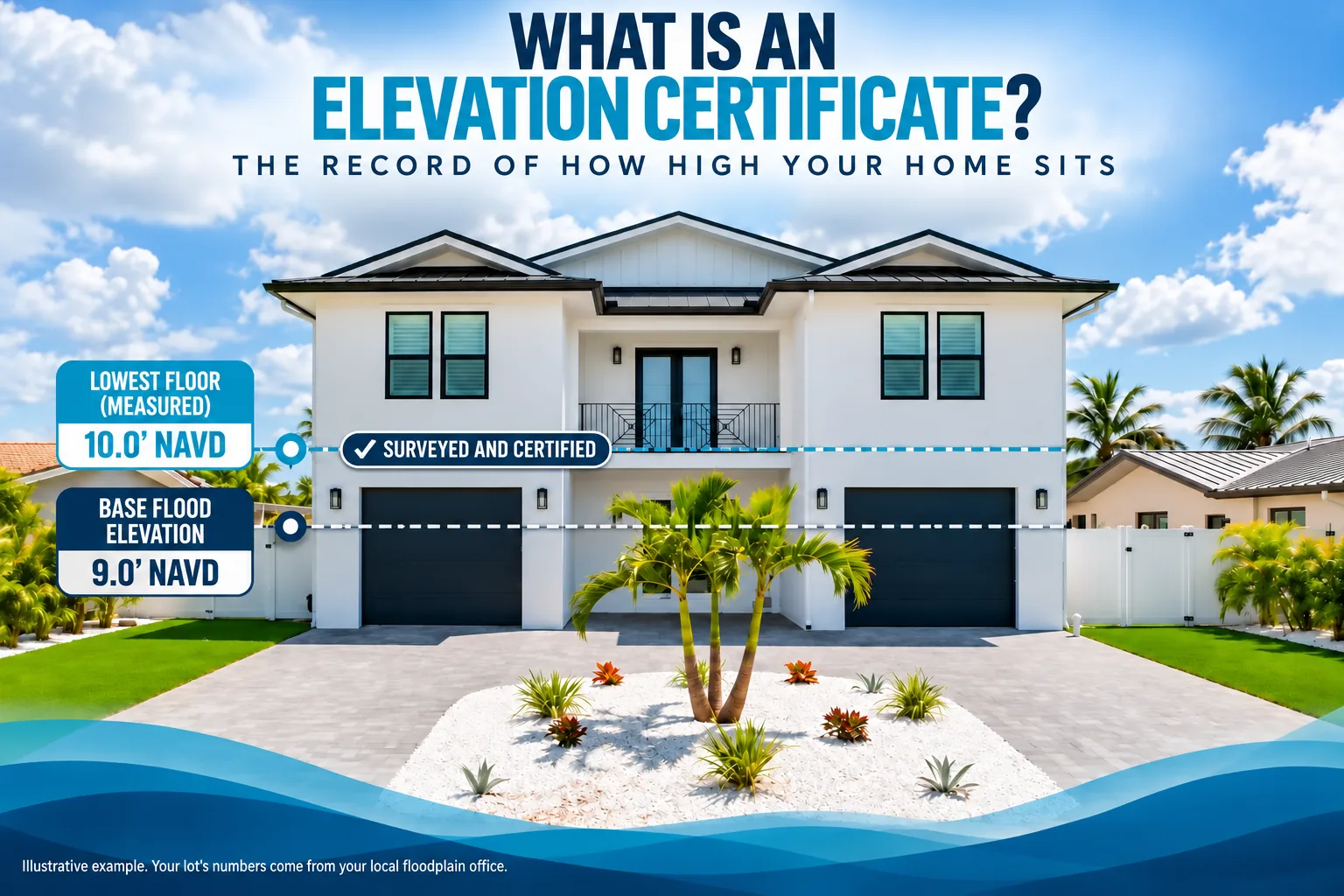
Short answer: An elevation certificate is a form that records how high a building sits compared with the expected flood level. It shows the flood zone, the base flood elevation (BFE) and the measured height of the lowest floor. In Florida flood zones, building departments use it to confirm a new home is built high enough, and owners can use it for flood insurance. A licensed surveyor usually prepares it.
What an elevation certificate shows
FEMA describes the elevation certificate as the official record, kept in the local permit file, that a new building in a high-risk flood area is properly elevated. The form usually includes:
- the property location, flood zone and FEMA map panel,
- the base flood elevation for the site,
- the height of the lowest floor (in most “A” zones),
- the height of the bottom of the lowest beam that holds up the home (in coastal “V” zones),
- the height of the ground around the building,
- the height of equipment such as air conditioning units, and
- photos of the building and details such as flood openings.
All heights are measured from the same reference point, called a vertical datum, so they can be compared with the BFE. Our guide to base flood elevation explains how the BFE is set.
Who prepares an elevation certificate?
The measurements are taken and signed by a licensed professional. In Florida, the building code asks for the as-built elevation to be prepared and sealed by a licensed professional surveyor and mapper or a registered design professional. In practice, most homeowners hire a land surveyor.
The owner or the local floodplain office can fill in some basic parts of the form, such as the address and flood map details, but not the certified measurements.
When do you need one in Florida?
When you build in a flood zone. For a new home in a high-risk flood area, your building department will ask for elevation documentation during construction. Many Florida communities ask for an elevation certificate at up to three points:
- Construction drawings: with the permit application, showing the planned elevations.
- Building under construction: once the foundation or lowest floor is in place, before building goes higher. This catches a height problem while it is still easy to fix.
- Finished construction: when the home, equipment and final grading are done. Many communities need this one before they issue the certificate of occupancy.
Your local building department confirms which stages apply to your lot.
When you buy flood insurance. Under FEMA’s current pricing approach (Risk Rating 2.0), you no longer need an elevation certificate to buy a National Flood Insurance Program policy. You can still give one to your agent, and the measured height of your home may be part of how your policy is priced. Ask your insurance professional whether a certificate would help in your case.
When you buy or sell a home. Sellers in flood zones often already have one. Ask for it early, because it tells you how the home sits compared with the flood level before you commit.
Elevation certificate, BFE and freeboard
These three terms work together:
- The BFE is how high floodwater is expected to reach.
- Freeboard is extra height above the BFE, required by local rules or chosen by the owner. Our freeboard guide covers how much Florida requires.
- The elevation certificate is the record that shows how high the home actually sits compared with both.
If the certificate shows the lowest floor below the required elevation, the building department may not approve the home until it is corrected. That is why the “under construction” certificate is checked before the home goes up.
How Seasafe approaches elevation
Seasafe builds elevated coastal homes using the Two-Site Construction Model. The concrete and steel ground floor is built on your lot while the living space sections are built at our Build Center, then set on top. Every Seasafe home is designed to the FEMA flood requirements and local flood codes that apply to its homesite.
We start with the lot, and every Seasafe build begins with a topographic survey. Surveys at several points during construction then check the home against its design, including its elevation. Seasafe arranges the elevation certificate, which the building department needs before it issues the final certificate of occupancy.
Talk to us about your lot
Send us your address and we will walk through what your site needs, including the flood zone, BFE and local requirements.
