
Coastal living is one of the biggest parts of the Florida lifestyle. People come for the water, the salt air, and a home that opens to the breeze. But building near the coast is not simple. High winds, weak soils, rising water, long permitting timelines, lack of skilled tradesmen, and unpredictable weather all create delays and uncertainty for homeowners.
After Hurricane Helene, these challenges became personal for families across the Gulf Coast. Many lost their homes overnight. Others were displaced for months while waiting for insurance responses and trying to figure out what to do next. Traditional building timelines of 18 to 24 months felt impossible for families who needed a place to live now.
Seasafe Homes was created to solve this problem. By combining an off-site building process with a traditional on-site construction method, Seasafe found a way to build stronger coastal homes in 16–24 weeks after permits, not years. For many homeowners recovering from the storm, this speed and structure made all the difference.
As homeowner Art McArthur said, “From permit to CO took a little over five months.”
This article explains how Seasafe re-engineered the coastal building process, how two-site construction works, and why homeowners like the McArthurs and Joe Nortz say Seasafe helped them rebuild not just their home but their sense of stability.
THE PROBLEM AND CHALLENGES WITH TRADITIONAL COASTAL HOMEBUILDING
Faster, Clearer Design and Engineering Process with Revit Software.
Before Seasafe redesigned its process, the design and engineering phase could take six to eight months. Architects, engineers, and drafting teams all worked in separate programs while trying to meet coastal building codes. When one person made a change, someone else had to adjust their plans to match. It was common for drawings to conflict with each other, which caused delays and pushed the entire project back before construction even began.
Introducing Revit changed that. Traditional home design often feels like trying to sort through multiple versions of a contract in a crowded email inbox—one person edits an old file, someone else reviews a different copy, and soon no one is sure which version is correct. Revit removes that problem completely. The entire design team works inside one shared 3D model, so everyone is always looking at the same, most up-to-date information.
When something changes in Revit, it updates everywhere automatically. Homeowners no longer have to keep track of email chains, printed drawings, or outdated PDFs. Everything stays organized and clear because the model includes the structure, electrical, plumbing, and mechanical systems; conflicts are found and fixed early instead of during construction when mistakes are costly.
Revit also helps homeowners visualize their home. Instead of trying to picture a space from a flat blueprint, they can see the layout in 3D and make confident decisions. This reduces back-and-forth, minimizes changes later, and speeds up approvals. What once took half a year can now be done in about 60 days, allowing the permitting and construction phases to begin much sooner.
Weather Delays Stretch Projects From Months Into Years
Coastal construction depends on dry weather. Storms, rain, and saturated soil stop concrete work, inspections, and framing. After a major hurricane, every builder in the region is busy. Crews are stretched thin, inspections get backed up, and even motivated homeowners can wait months before seeing progress on a traditional build.
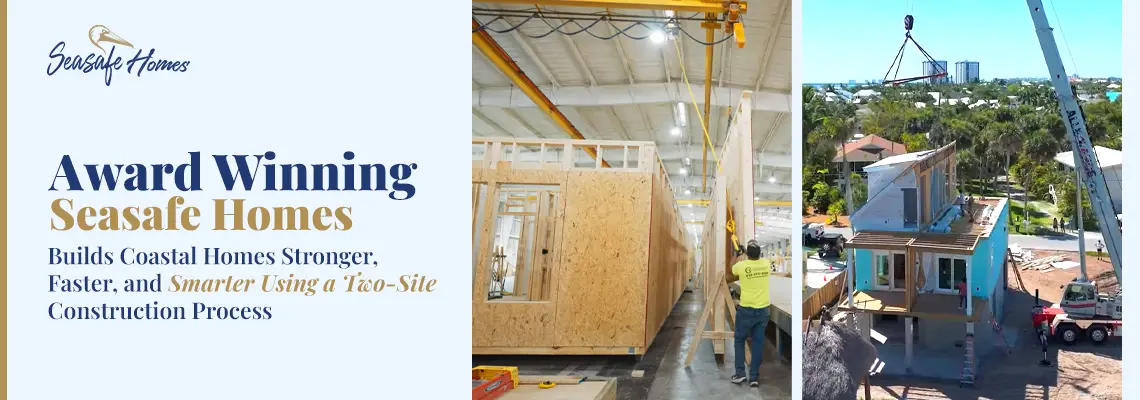
Seasafe reduces that waiting by separating what has to happen outside from what can happen inside. While the foundation, pilings, and ground floor are built on the homesite, the living areas are built indoors at the Build Center. The Build Center does not shut down when it rains. Material deliveries are not ruined by the weather. Crews are not standing around waiting for the ground to dry out. That means work continues even during long stretches of bad weather.
Because much of the work is done in this protected environment, the schedule is more predictable. You are not losing weeks every time a storm system moves through. For families rebuilding after Hurricane Helene, this made a real difference in how quickly they could get back home.
A Guided Coastal Design Process Without the Overwhelm
Traditional custom homes often ask owners to make more than 1,000–1,500 choices. Every room. Every finish. Every tiny detail. In normal times, that can feel like a lot. After losing a home in a storm, it can feel impossible. People are juggling insurance claims, temporary housing, storage units, work, and family needs.
They simply do not have the bandwidth to manage a full-time design process on top of everything else.
Seasafe trims that burden on purpose. Instead of handing homeowners a giant catalog, Seasafe uses curated finish groups created by a professional designer.
These options are already coordinated, so homeowners are choosing from combinations that look good together and match the relaxed coastal lifestyle many people want. It feels more like choosing a style than managing a project.
Homebuyers still shape their home. They pick exterior architecture such as coastal contemporary or Key West and personalize the kitchen, bathrooms, flooring, and fixtures. The choices stay meaningful, not overwhelming. This lets homeowners express their coastal style while keeping the process simple and enjoyable.
Because the selections are streamlined, the project stays on schedule. Homeowners are not stuck for weeks trying to match tile to paint or compare dozens of countertop samples. They make clear decisions in a few focused meetings and move forward with confidence, knowing the home will feel cohesive, fresh, and tailored to the way they want to live.
Joe appreciated this most of all. “I wasn’t overwhelmed with choices. They kept it reasonable,” he said. This approach reduces stress, protects the build timeline, and helps families focus their energy on the bigger task—rebuilding their life, not just their house.
SEASAFE’S SOLUTION: THE TWO-SITE CONSTRUCTION METHOD
Seasafe uses a two-site building process. Instead of waiting for one phase to finish before the next begins, Seasafe builds the foundation on the property at the same time the living areas are being constructed indoors at the Build Center. This parallel approach shortens the building timeline by months. With multiple trades working at the same time, months can be cut off a traditional coastal construction timeline.
As homeowner Joe Nortz said, “Less than a year after the hurricane, the house was done.”
What Happens at the Offsite Build Center
At Seasafe’s Build Center in Georgia, the living areas of the home are built indoors in a controlled environment. This keeps materials dry, allows for consistent workmanship, and eliminates many weather-related issues that slow down traditional construction.
Another added benefit of the controlled environment is the availability of materials, tools, and equipment needed to complete tasks. If anyone has done construction (either new construction or home remodeling), they know how often they need to run down the street to the local store to pick up a needed item. With everything under one roof, these time-killing occurrences are greatly reduced.
Inspections happen throughout the build, and all Seasafe living areas are engineered for 180-mph wind zones. Inspectors are certified and educated on all local building codes required for the home to meet the standards. Many homeowners notice the strength and finish long before the home is installed. Joe shared, “These builds are very solid. The craftsmanship was done very well.”
What Happens Onsite
While the home is being built in Georgia, Seasafe’s onsite team prepares the property. They install pilings based on engineered soil reports, build the concrete and steel ground-floor structure, coordinate utilities, and complete required inspections. Because both places—the Build Center and the homesite—are working at the same time, the project moves forward without long gaps.
Set Day is When Offsite Meets Onsite
Set day is often the most emotional moment of the entire project. It is the day the house finally arrives. The completed sections of the home travel from the Build Center on specialized transport trucks, each home section wrapped, protected, and ready for installation. When the convoy turns onto the street, neighbors usually come outside to watch. Many homeowners say this is the first moment the rebuild finally feels real.
A large crane is brought onto the property to lift each section into place. Before the crane begins, crews walk the site, review the plan, and talk through the sequence so everything moves safely and smoothly. Once the first section lifts into the air, the day takes on a different energy. Bedrooms, kitchens, hallways, and rooflines that were built indoors now rise above the homesite and are carefully lowered onto the elevated foundation.
Within a few hours, the shape of the home becomes clear. Rooms that existed only on paper and in a digital 3-D space now stand in front of the homeowner. Windows line up, doors fit into place, and the outline of the coastal design comes together. For many families, this moment brings a wave of relief. “Seeing it come together in one day was incredible,” Joe said. After months of uncertainty, seeing so much progress in a single day feels almost unreal.
For Dana, it was more than progress. It was an emotional release. She said it felt like the first moment she could breathe since losing her home. Months of displacement, paperwork, and stress finally lifted as she watched her new home take shape.
After the main sections are set, crews connect the structure, secure all tie-downs, and weatherproof the seams. By the end of the day, the home is standing strong, elevated, and ready for the finishing phases. Homeowners often take pictures and start imagining family gatherings and normal life returning.
Set day is more than construction. It is a turning point, offering a glimpse of relief, hope, and real progress after a long season of loss and waiting. It is the day the house becomes a home again.
ENGINEERING A HOME FOR COASTAL STRENGTH
Hurricane Helene changed what homeowners expect from a coastal home. People no longer want a house that simply meets minimum code—they want something that feels genuinely safe. Seasafe designs reflect those expectations by going well beyond the basics. Each home is engineered for 180-mph wind zones, with reinforced exterior walls, engineered trusses, and continuous load paths that tie the roof to the foundation. This creates a structure designed to stay intact during severe storms.
Strength starts at the ground. Seasafe uses engineered pilings that are drilled deep into soft coastal soils, giving the home long-term stability even during storm surge or saturated ground conditions. On top of the pilings, the ground-floor structure is built with concrete, steel, and hurricane-rated connections. Every Seasafe home is elevated above FEMA flood levels, which protects the living space and mechanical systems. After losing her home to flooding, Dana said, “Knowing we’re elevated gives us peace of mind.”
One of the strongest examples of Seasafe’s approach is the home of Dana and Art McArthur, which won a 2025 Mark Samuelian Resilience Award. Their new home replaced a 1952 house that sat at just four feet of elevation and had flooded repeatedly. Seasafe rebuilt it as a middle-income home elevated 17 feet, which is four feet above the required code. The home sits on deeply embedded pilings and includes above-code windows, doors, wall assemblies, and a metal roof. The living areas were built in two sections at the Build Center, transported to the site, and lifted onto the concrete and steel columns by crane.
The project reduced environmental impact through lower material waste and improved thermal performance. It also benefited the neighborhood by cutting the typical construction timeline by nearly 70%, which meant less noise, fewer disruptions, and a much quicker return to normal activity on the street.
These are the types of improvements celebrated by the Mark Samuelian Award program. As Aris Papadopoulos, FIU resilience expert and Chair of the Resilience Action Fund, said:
“For the 3rd consecutive year Mark Samuelian’s legacy continues with a focus on affordable resilience for middle- and lower-income households. This year’s winners are great models that combine resilient vision, technology and execution at the local level, which can be applied elsewhere in Florida, the US and the World.”
The Mark Samuelian Awards in Residential Resilience recognize individuals and organizations that demonstrate practical, real-world success in creating homes that are built to withstand hazards. The awards highlight projects that use better materials, smarter engineering, and stronger design strategies, especially for families who need affordable and dependable housing. Seasafe’s work is now part of that growing national example.
For homeowners like Joe, the results speak for themselves. “I feel good about this build. It’s very solid,” he said. Seasafe’s engineering is more than compliance—it is a commitment to safer, stronger, more resilient coastal living for everyday families.
COASTAL LIVING WITH CONFIDENCE
At its core, Seasafe’s process is about more than speed. It is about giving families a safe and stable place to live near the coast without the usual fears and frustrations of rebuilding after a hurricane. For families like the McArthurs, the process meant returning home sooner and feeling safe again. For homeowners like Joe, it meant rebuilding a life that had been turned upside down.
Joe said it plainly: “I lost everything. Seasafe helped me get my life back.”
