
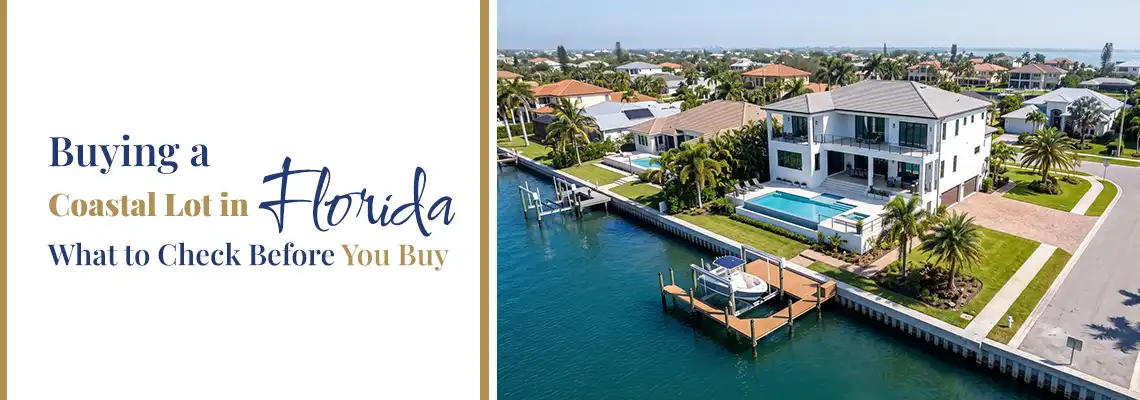
On the coast, the listing price is the smallest number in the deal. Here’s how to find a lot’s true cost — and avoid the expensive surprises.
Two coastal lots can be listed within a few thousand dollars of each other and turn into completely different projects. The difference isn’t in the asking price — it’s in the seawall, the water depth, the trees, the drainage, and the flood maps. Before you make an offer on a Florida coastal lot, these are the things that actually decide what it will cost to build the home you want.
The listing price is the smallest number
A lot’s price is a starting point, not the finished cost to build. Site work — seawalls, docks, demolition, tree removal, drainage, and utility runs — can move the real cost far more than the sticker does. The smartest coastal buyers evaluate the total cost to a finished, elevated home, not the number on the listing.
The coastal-lot hidden-cost checklist
Before you make an offer, work through this list. Any one of these can change the economics of a lot:
✓ Seawall condition and age. Replacement is a major expense. An aging seawall on a “cheaper” lot can erase the savings.
✓ Dock condition and water depth at low tide. Owning waterfront doesn’t guarantee you can dock a boat — depth, access, and dredging limits all matter.
✓ Demolition. Any existing or storm-damaged structure has to come down first, and that’s a line item.
✓ Tree and foliage removal. Large or protected trees can be costly to remove and may sit right where you want the home.
✓ Buildable footprint after setbacks. The land you can actually build on is often smaller than the lot itself. Check the setbacks early.
✓ Base flood elevation, topography, and drainage. This is the sleeper. Elevation and drainage decide whether a driveway or garage stays dry in ordinary summer rain and high tides — not just during hurricanes. Nearby areas can differ by a couple of feet, and that changes everything.
✓ Utilities. On irregular or deep lots, running power, sewer, and water can cost more than expected.
How lot shape changes what you can build
Pie-shaped lots often sit at the end of a street with the wide end on the water — which can mean more seawall frontage, more dock room, and a bigger, more usable backyard, where waterfront owners tend to spend their time.
Corner lots can look larger but often have a smaller buildable footprint: fronting two streets can mean two front setbacks instead of one, sometimes trimming a meaningful share of the footprint on each floor. The upside is design flexibility, like a side-entry garage. (The exact impact depends on your municipality’s rules — worth checking for the specific lot.)
Waterfront lots carry a value premium driven by open-water versus canal views, how wide the water is across from you, closeness to the intercoastal, and orientation — a south-facing rear gets sun all winter, east-facing catches the sunrise, west-facing the sunset.
Irregular and deep lots can allow creative design and entry sequences, but keep an eye on longer utility runs, which add cost.
Why good coastal lots are getting scarcer
After recent storms, many older homes built below today’s base flood elevation were damaged past the point of simple repair and now have to be rebuilt to current elevation and code. As those homes are replaced with compliant new construction, the supply of rebuildable waterfront becomes more limited over time — one reason a well-chosen lot today is worth the diligence.
A tale of two lots
Here’s an illustrative example of why sticker price misleads. Say Lot A is listed at $400,000: it’s cleared, with a new seawall and a new dock, ready to build. Lot B is listed at $375,000, but it has an older home on it, heavy tree cover, an aging seawall, and no dock. On paper, Lot B looks cheaper. Once you add demolition, tree removal, a new seawall, and a dock, Lot A can easily end up the less expensive lot — despite the higher listing. (These figures are illustrative, not a quote.) The lesson: compare the finished cost to build, not the price on the sign.
Evaluate the lot before you design
The most expensive surprises happen when design runs ahead of the site. Seasafe works from proven, pre-established plans that we adapt to your needs and your lot — and we evaluate the lot and site conditions early: whether the home fits, whether the footprint works, whether the height is right, and where the buildability constraints are. That means you’re not designing in a vacuum, and you’re not paying to discover problems late.
The Coastal Lot Buyer’s Checklist
On the coast, the listing price is the smallest number in the deal. Work through this checklist before you commit — any one item can change what a lot really costs to build on.
| ☐ | Seawall condition and age
Replacement is a major expense; an aging seawall can erase a lower list price. |
| ☐ | Dock condition and water depth at low tide
Waterfront doesn’t guarantee you can dock a boat — depth, access, and dredging limits matter. |
| ☐ | Demolition
Any existing or storm-damaged structure has to come down first. |
| ☐ | Tree and foliage removal
Large or protected trees can be costly and may sit where you want the home. |
| ☐ | Buildable footprint after setbacks
The land you can build on is often smaller than the lot — check setbacks early (especially on corner lots). |
| ☐ | Base flood elevation, topography & drainage
The sleeper: decides whether the lot drains in ordinary rain and high tides, how you’ll elevate to code, and your insurance picture. |
| ☐ | Utilities
On irregular or deep lots, running power, sewer, and water can cost more than expected. |
| ☐ | Total cost to build — not sticker price
Add demolition, seawall, dock, trees, and site work before you compare two lots. |
| ☐ | A site-specific evaluation
Confirm the lot fits the home you want — footprint, height, buildability — before you commit. |
Flood laws, codes, setbacks, and elevation requirements change and vary by location — sometimes street to street. This checklist is educational, not project-specific compliance advice. Confirm the current rules for your specific lot before you commit.
Found a lot you’re considering?
Seasafe helps buyers evaluate a coastal lot’s true build potential before you buy. Reach out and we’ll walk the checklist with you.
Before you buy: a note on local rules
Confirm the rules for your specific lot
Flood laws, building codes, setbacks, and elevation requirements change over time and vary by location — sometimes street to street. This guide is educational and is not project-specific compliance advice. Confirm the current requirements for your specific lot and municipality, and get a site-specific evaluation before you commit.
Thinking about a coastal lot?
Seasafe helps buyers evaluate a lot’s true build potential — before you buy. Talk to us early and we’ll help you weigh the total cost, the buildable footprint, and the site conditions that matter most on the coast.
